
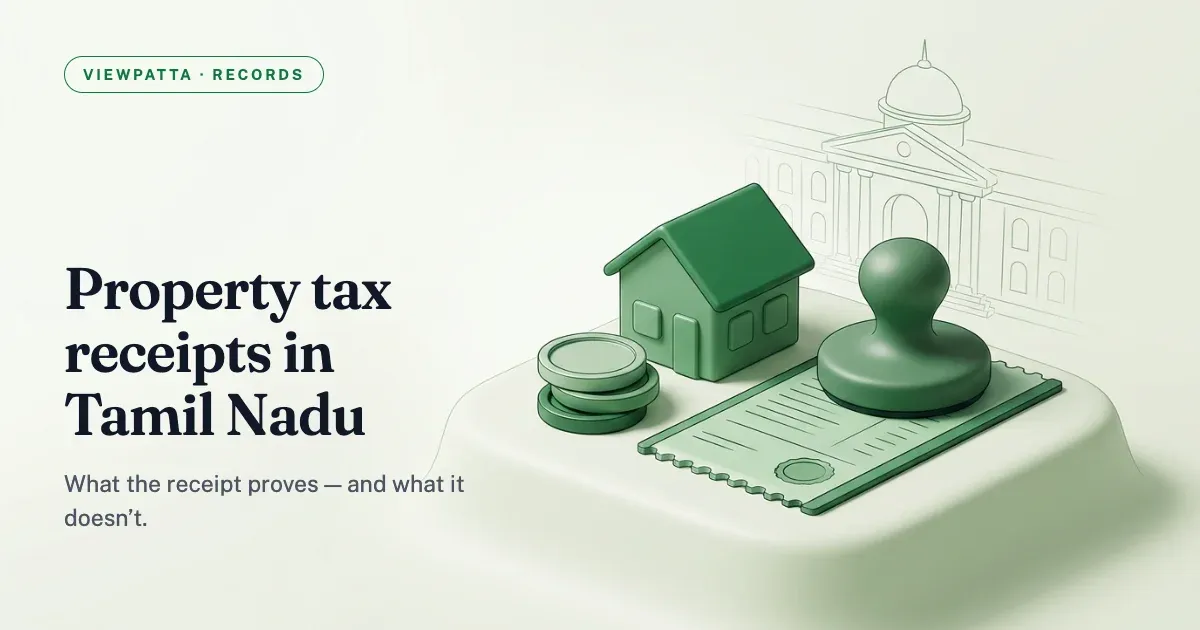
A property tax receipt often gets waved around as proof of ownership when someone is comparing a seller’s paperwork before buying land in Tamil Nadu. By the end, you will know what a property tax receipt actually shows, why the name on it can differ from the patta, and how to weigh it against the patta, the encumbrance certificate and the deed chain rather than on its own.
What does a tax receipt prove?
A property tax receipt proves only that someone paid the local body’s tax on a property for a given period — it is not evidence of ownership. Municipalities, corporations, town panchayats and village panchayats issue receipts to whoever comes forward and pays, without verifying title first. The patta, the chitta and the registered deed chain are what revenue authorities and courts treat as establishing rights over land; a tax receipt sits alongside them as a supporting record at best. Keep that distinction in mind when a seller or broker offers a stack of receipts as their main proof of ownership.
Who collects the tax, and where?
Which office issues the receipt depends on where the property sits. Land inside a municipality, town panchayat or city corporation pays property tax to that urban local body, usually at its own counter or through its own online portal. Land under a village panchayat pays house tax or property tax to the panchayat, often through a different system, and both the terminology and the receipt format can vary from one panchayat or town to the next. This sits apart from the Tamil Nadu e-Services portal, which handles patta, chitta, A-Register and FMB records, and from TNREGINET, which handles registered deeds and encumbrance certificates.
Why can the name lag?
The name on a tax receipt can lag behind the patta or the deed because paying tax and updating ownership records are two separate processes. Registering a sale deed at the sub-registrar’s office does not by itself update the patta, and it typically doesn’t update the property tax rolls either — each needs its own application. A previous owner, an heir, or even a tenant may have been the one paying the tax, so the receipt can carry a name unrelated to who currently holds the patta or the deed. Treat a mismatch as a prompt to ask questions, not as something unusual on its own.
Is possession plus receipts enough?
Possession and a stack of tax receipts alone is a weak position because neither one proves title. Local bodies generally accept payment from whoever comes forward without checking who legally owns the property, so someone can occupy land and pay tax on it for years without holding valid title to it. Where a dispute arises, what typically settles it is the patta-chitta record, the registered deed chain going back through previous owners, and the encumbrance certificate for the relevant period — not the tax rolls. Relying on possession and receipts as your main evidence, without checking these other records, carries real risk.
How should buyers read the receipt?
Read the tax receipt as one supporting signal alongside the patta, the EC and the deed chain, not as proof on its own. Check that the survey number, extent and property description on the receipt match what appears on the patta and the deed. Ask the seller for receipts covering recent years to see whether payments have been continuous and in whose name, since both gaps and a name that changed suddenly are worth asking about. A clean run of receipts is reassuring, but on its own it only means tax has been paid, not that the seller’s title is sound.
- Survey number and extent match the patta
- Payments continuous, with no long gaps or pending dues
- Name on the receipt matches the current patta and deed holder
- Property description matches what’s in the deed
What should a name mismatch prompt?
A mismatch between the receipt name and the patta name should prompt questions before you go further, not an assumption that something is wrong. Ask the seller why the names differ — a pending mutation after inheritance, an older unregistered transfer, or a simple administrative delay are all common and often explainable. Where the explanation is unclear, or where different names appear across the patta, the deed chain and the tax receipt, take qualified legal or survey advice before proceeding, since sorting out who actually holds title can mean checking records beyond what a receipt or a patta search alone shows.
How do you transfer the tax name?
After you buy a property, you typically apply to the local body to have the property tax records updated to your name, alongside or after applying for patta transfer on the revenue side. This is a separate application from the patta mutation, even though both follow from the same sale, so completing one does not complete the other. Requirements vary by municipality, corporation, town panchayat and village panchayat, so check with the local body’s office or portal for what it asks for. Keeping both records current in your name closes the gap that otherwise confuses the next buyer.