
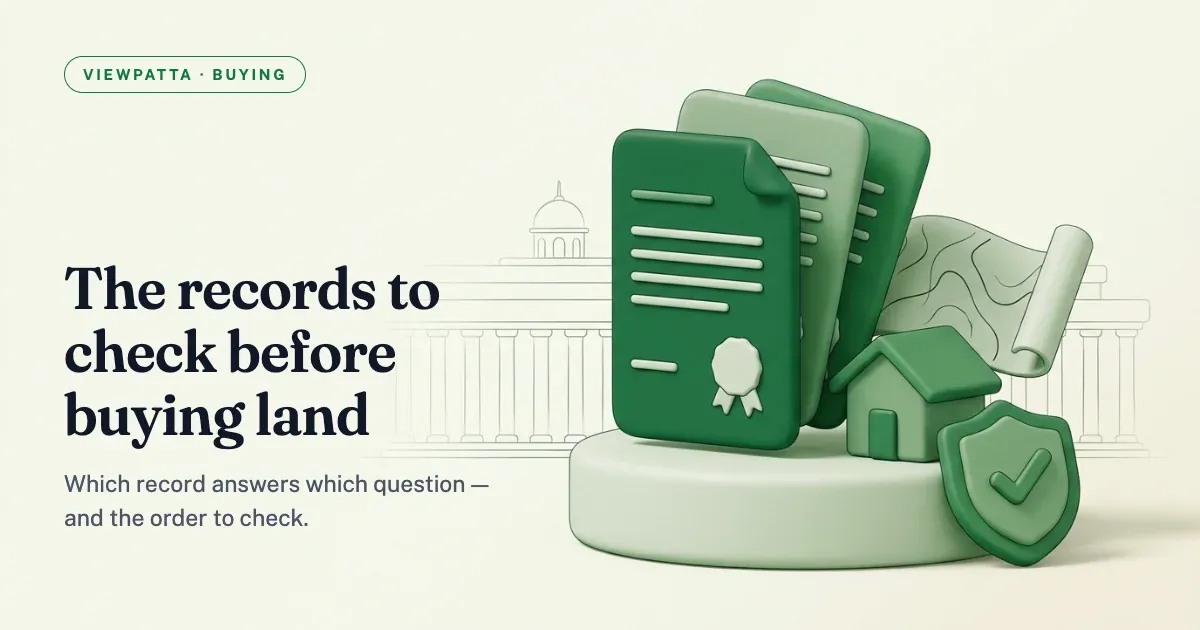
Patta, EC, FMB and the A-register each answer a different question about a parcel. None of them answers every question. Checking them in the right order surfaces problems early, while walking away is still cheap.
Start with the patta
The patta tells you who the revenue records name for the parcel, its classification and its recorded extent. If the seller is not on the patta, ask why before anything else — there are legitimate reasons, such as an unrecorded inheritance, but each one needs a paper trail.
Then the encumbrance certificate
An EC is a registration search: it lists the registered transactions indexed against the property for the period you request. Mortgages, prior sales and attachments show up here. Ask for a long period — thirty years is common — and read every entry, not just the latest.
Then the FMB sketch
The field measurement book sketch shows the surveyed shape and measurements of the survey number. Take it to the land and walk the boundaries. A parcel that measures differently on the ground than on paper is a problem to resolve before registration, not after.
Then the A-register extract
The A-register records the classification history of the survey number — including whether any part is government land or poramboke. A patta is not issued for government land, so a seller offering one for such a parcel is a signal to stop.
Tie them together
The records must agree with each other and with the deed chain. The same names, the same survey number and subdivision, the same extent. Where they disagree, the disagreement is the finding — take the documents to a lawyer before you commit.
- Patta: who the revenue records name, classification, extent
- EC: registered transactions and encumbrances over a period
- FMB: the surveyed shape and measurements
- A-register: classification history, government-land check
- Deed chain: what was actually registered, in whose favour
What online copies are for
Records fetched online are information copies — the fastest way to see what the government data says before you spend on site visits and legal review. For registration, a court or a bank, confirm which certified format the receiving office requires.