
Tamil Nadu land records
Patta Chitta Report for a Tamil Nadu Village (பட்டா சிட்டா தொகுப்பு)
A Patta Chitta report compiles every patta and chitta entry for one Tamil Nadu revenue village into a single spreadsheet, one row per sub-division. Pick the district, taluk and village and you pay only once a price and working-day target are shown.
Search the record
Fetching your record
Usually done in under 30 seconds.
Keep this tab open while we fetch your record.
What we're fetching
Progress
0:00
Your order
Result
You have not been charged. ₹0.
Use cases
- Building a village-wide list of every patta before deciding where to focus due diligence
- Cross-checking one patta against every other holding recorded in the same village
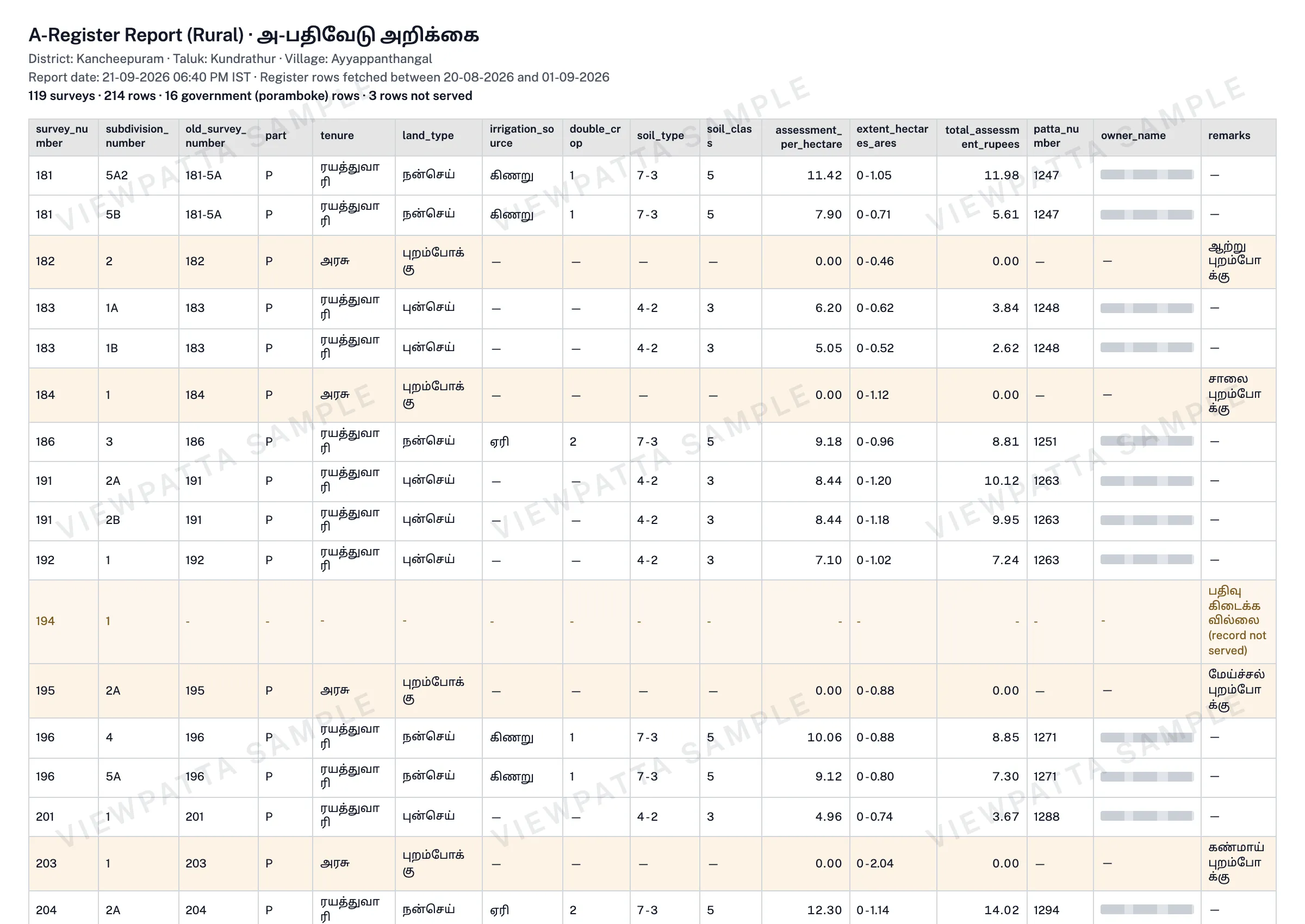
- Finding parcels the portal has no data for, before relying on any single patta
Overview
Patta Chitta report overview
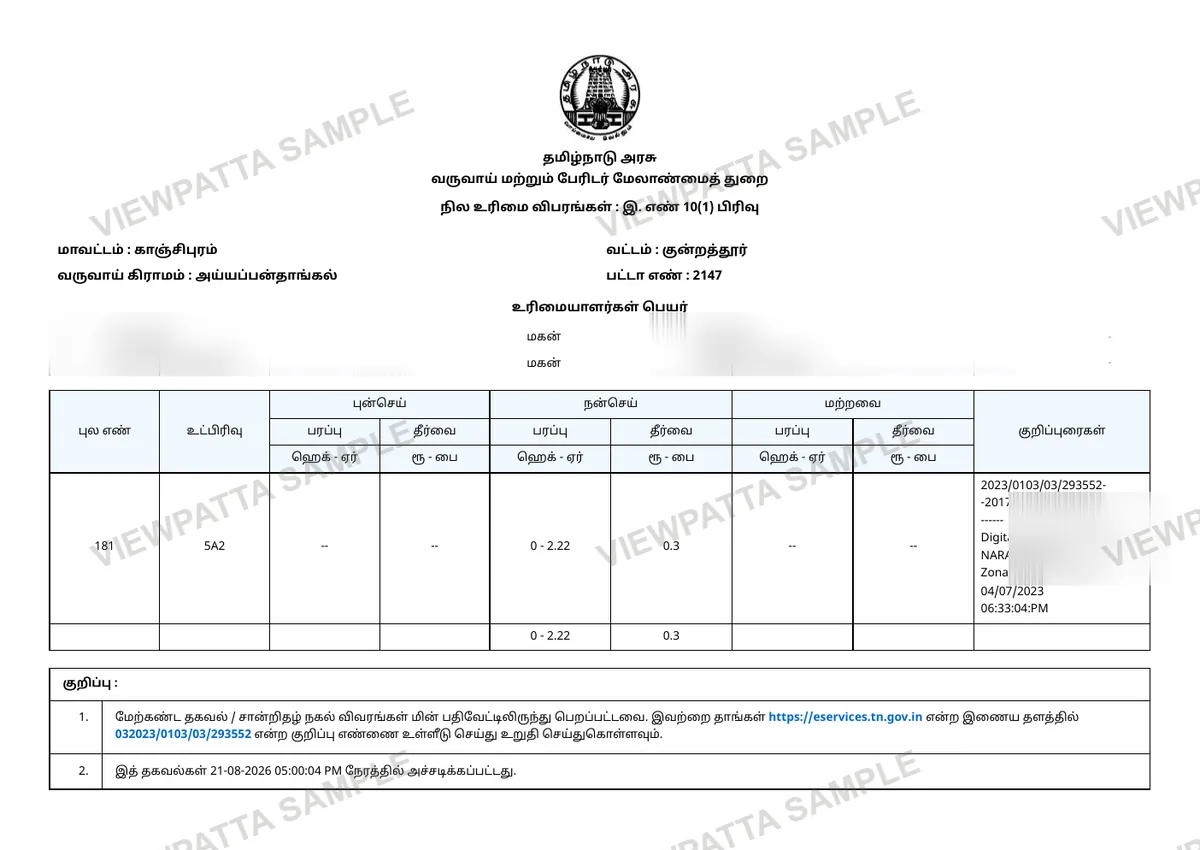
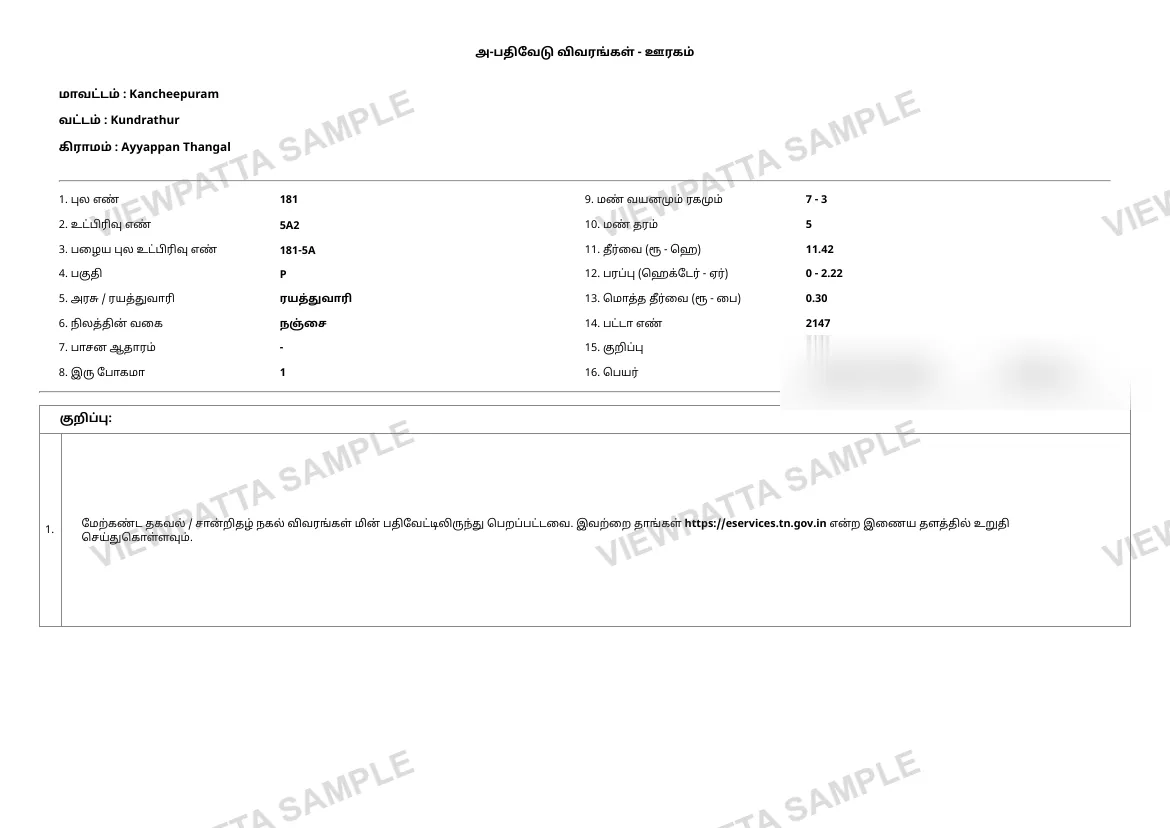
A Patta Chitta report (பட்டா சிட்டா தொகுப்பு) is a whole-village roll built from the Tamil Nadu e-Services land-record portal: every patta the portal returns for the revenue village you choose, as a flat table with one row per sub-division and the district, taluk, village and patta number repeated on every row, so the sheet can be filtered, sorted and pivoted. A visible gap row marks any parcel the portal listed but could not return details for. It covers rural and natham land; government and poramboke land carries no patta, so it never appears in a patta-keyed roll — an A-register report covers that ground. You choose only the district, taluk and village; no survey number or patta number is asked for. The order is priced and charged before the roll is compiled, and delivered as an XLSX spreadsheet, not a PDF or certificate. This is an information copy, never a certified copy or proof of title.
Record guide
What do the terms mean?
- Patta group
- One block of rows in the roll: every entry recorded under a single patta number.
- Subtotal row
- The row summarising extent and parcel count for the patta group above it.
- Gap row
- A row marking a parcel the government portal lists but returned no usable details for.
- Natham
- House-site land inside a village settlement, covered by this roll along with rural agricultural land.
- Government / poramboke land
- Land with no patta. It is not covered here because a patta-keyed roll has nothing to key it to.
Troubleshooting
Why might the result not appear?
- A large village takes longer to compile, and a small share of parcels return no usable data — hence the gap rows.
- The roll is keyed to patta, so government and poramboke land never appears in it.
- A recently split or merged patta may show under its new number only, not the old one.
- A holder name is recorded with a different spelling from the sale deed.
- The roll reflects what the portal returns on the day it is compiled and can differ from a very recent mutation.
What this record cannot establish
A Patta Chitta report is an information copy of what the government portal held for the village on the day it was compiled. It does not by itself establish legal title, possession or an on-ground boundary, and a missing or gapped row does not by itself mean a parcel has no valid patta — reconcile any parcel you rely on against its own Patta Chitta record, the sale deed and other evidence.
Verification checklist
How to use this record
- Choose the district, taluk and revenue village you want the roll for.
- Confirm the price and the working-day target shown before you pay.
- Open the delivered spreadsheet and locate the patta group for the parcel you care about.
- Filter to that patta number and check the rows and extent against what you expect.
- Treat any gap row as unresolved and search that parcel on its own before relying on it.
Search help
What details should you keep ready?
Pick the district, taluk and village. No survey number, patta number or subdivision is needed — the report covers the whole village.
Guides
Read before you search
Related tools
Continue checking the property
Questions
Before you start.
Including the two most people ask: whether we are the government, and what happens if the record is not there.
What is a Patta Chitta report?
A Patta Chitta report is a whole-village roll: every patta and chitta entry the government portal holds for one revenue village, compiled into a single spreadsheet with one row per sub-division and every fact repeated on each row.
What do I need to order one?
Only the district, taluk and revenue village. No survey number, patta number or subdivision is asked for — the report covers every patta in the village.
When do I pay, and what happens if the roll cannot be compiled?
You pay after the order is accepted, once a price and a working-day target are shown, and before the roll is compiled.
If the portal cannot return a usable roll for the village, the payment is refunded in full and automatically — you do not need to ask.
What format does it come in?
An XLSX spreadsheet, opened in a spreadsheet application such as Excel or Google Sheets. It is not a PDF and not a certificate.
Does the report include government or poramboke land?
No. The roll is grouped by patta, and government and poramboke land has no patta to group it under. An A-register report covers that ground instead.
Why does my village’s roll have gap rows?
A gap row marks a parcel the portal lists but could not return usable details for on the day the roll was compiled. It is not evidence that the parcel lacks a valid patta — check that parcel on its own before relying on the gap.
Is a Patta Chitta report proof of ownership?
No. It is an information copy of revenue records, not a certified copy or proof of title. Reconcile any parcel you rely on against the registered deed and other evidence.